
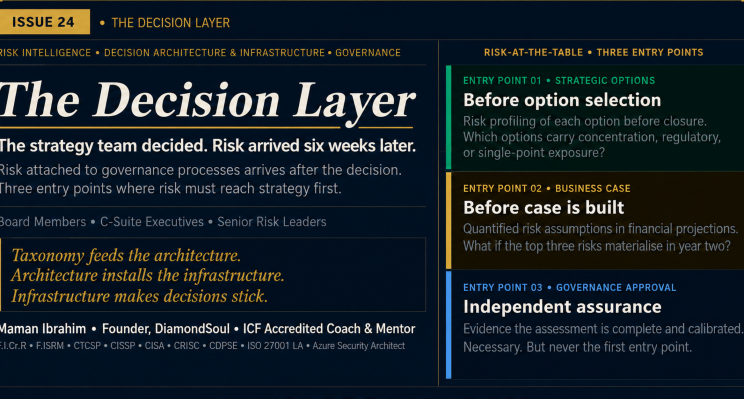
The Decision Layer #24: Risk Must Enter Before the Decision
Issue 24· 7 min read· Board Members · C-Suite · Senior Risk Leaders This week: A global retailer makes a major market entry decision. Risk management is involved six
Read intelligenceIssue 24· 7 min read· Board Members · C-Suite · Senior Risk Leaders This week: A global retailer makes a major market entry decision. Risk management is involved six
Read intelligenceThe agent never broke its transaction limit. The organisation still lost control of the aggregate decision. This Board Case Study applies the Decision Infrastructure™ lens to show why AI boundaries must govern exposure, not merely individual actions.
Read intelligenceFive signals show why identity and access controls cannot substitute for a mandate. The decision boundary has to state what an agent may decide, what needs confirmation, and what it must never decide.
Read intelligencePermission is technical. Authority is organisational. This issue maps the decision boundary between what an agent can do and what the organisation has actually delegated.
Read intelligenceDecision Infrastructure is the layer that makes consequential decisions authorised, evidenced, bounded, traceable, challengeable and capable of being reopened when the facts change. This Founding Edition introduces its six components.
Read intelligence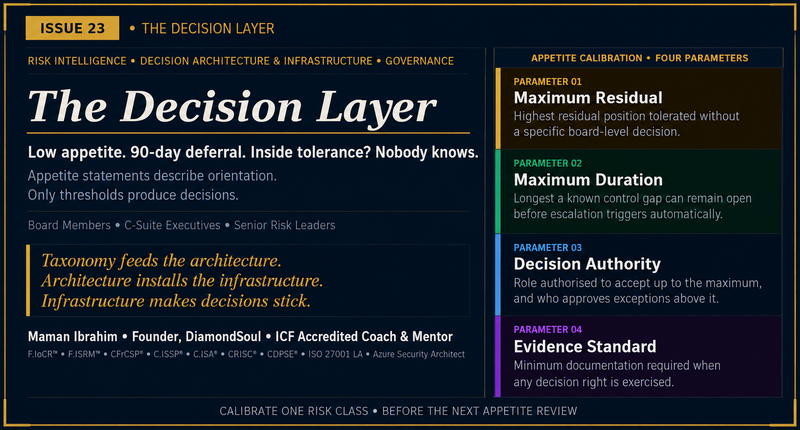
A cyber patch deferral exposes the weakness of vague risk appetite statements. Four calibrated thresholds turn orientation into a decision boundary.
Read intelligenceSeventy-one days to the next hard EU AI deadline. This edition tracks what moved across the EU AI Act, Cyber Resilience Act, NIS2, financial services and post-quantum regulation, and highlights the dates, stale assumptions and ownership gaps that now matter most.
Read intelligence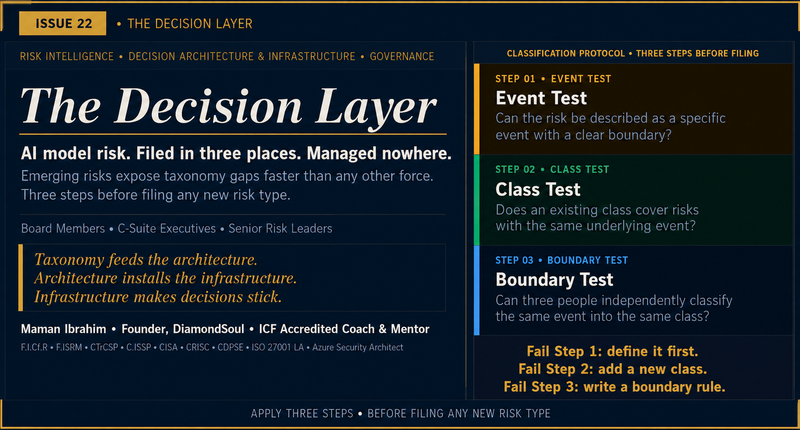
AI model risk filed three different ways exposes a deeper problem: emerging risks surface taxonomy gaps faster than almost any other force. A three-step classification protocol brings consistency before filing.
Read intelligenceA composite insurer shows how AI cost, weak authority, agent sprawl, shadow AI and third-party model changes can compound into a board problem nobody owns.
Read intelligenceFive signals on agentic AI adoption, from permission sprawl and shadow AI to procurement, governance tooling and agents arriving through licence renewals.
Read intelligenceAutonomous agents are gaining human access without human accountability. Issue 02 examines ownership, stop rights, approval gates, and the evidence boards should ask.
Read intelligence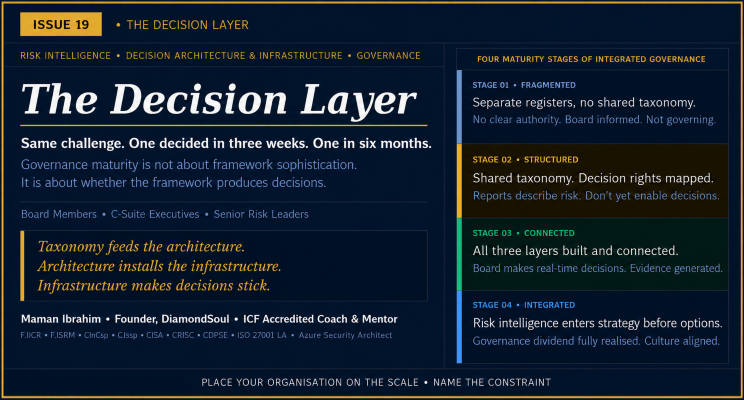
Two organisations faced the same regulatory challenge. One produced a board decision and complete evidence trail in three weeks. The other was still consulting six months later. The difference was governance architecture.
Read intelligence