
Sharp. Not sentimental.
The Supplier Gave 60 Days' Notice. The Committee Meets in 45. Nobody Could Decide in the Gap.
A utility's critical data centre services supplier gave 60 days' notice of contract exit. The supplier relationship had been a Tier 1 vendor for six years. The operational consequences of an unmanaged exit were significant.
The risk committee — the body with authority to approve the remediation spend required — was scheduled to meet in 45 days. Standard governance said: prepare a paper for the committee.
The operations team needed to begin procurement of alternative services within two weeks to have any realistic chance of a managed transition. The risk committee meeting was 45 days away. The 15-day gap between when the decision needed to be made and when the committee would meet was ungoverned. The operations team could not act without authority. The authority body would not convene for 45 days.
The committee eventually made the decision via email sign-off from individual members. The governance record for a seven-figure remediation commitment was a chain of email replies. The committee ratified it at the scheduled meeting, six weeks later.
Honest. Not accusatory.
Governance Cadence Built for Periodic Review Cannot Accommodate Decision Speed Requirements.
Quarterly committees, monthly steering groups, and annual planning cycles are designed for the rhythm of normal governance — oversight, review, ratification. They are not designed for the rhythm of operational risk events, which arrive on their own schedule and frequently require decisions faster than the next committee meeting.
The gap between when a decision is needed and when the authority body next convenes is an ungoverned space. Decisions made in that space are either deferred until governance catches up — at operational cost — or made outside governance by individuals who technically lack the authority — at governance cost.
Most organisations manage this gap through informal workarounds: email chains, emergency calls, verbal sign-offs that are later ratified. These workarounds produce governance trails that look like compliance and behave like improvisation.
Simple. Not simplistic.
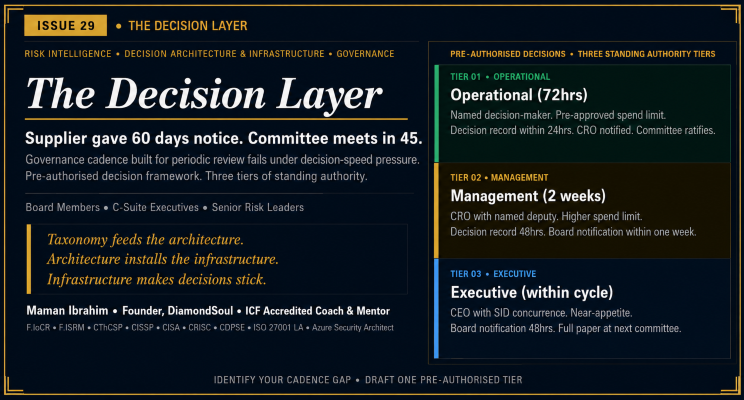
The Pre-Authorised Decision Framework: Three Tiers of Standing Authority.
Pre-authorised decision frameworks resolve the cadence gap by establishing standing authority for defined categories of decision — authority that activates when specific conditions are met, without requiring a committee to convene.
| TIER | CONDITIONS | STANDING AUTHORITY | DOCUMENTATION REQUIRED |
|---|---|---|---|
| Operational | Risk event requires decision within 72 hours. Decision is within defined class and threshold. | Named operational decision-maker. Pre-approved spend authority up to defined limit. | Decision record within 24 hours. Notification to CRO same day. Committee ratification at next scheduled meeting. |
| Management | Risk event requires decision within two weeks. Decision exceeds operational threshold but is within management appetite boundaries. | CRO with named deputy. Pre-approved spend authority up to defined limit. | Decision record within 48 hours. Board notification within one week. Committee ratification at next meeting. |
| Executive | Risk event requires decision within committee cycle. Decision is at or near appetite boundary but within board delegation. | CEO with named senior independent director concurrence. Pre-approved spend authority up to defined limit. | Board notification within 48 hours. Full governance paper at next committee meeting. |
The critical design element is the documentation requirement. Pre-authorised decisions are not ungoverned decisions — they are decisions made under standing authority, with an accelerated documentation trail and mandatory ratification at the next scheduled governance event. The speed is in the activation. The governance is in the record.
Practical. Not obvious.
Identify Your Governance Cadence Gap. Close It With One Pre-Authorised Tier.
Look at your current governance calendar and your critical risk categories.
The draft conditions are the governance decision. Who has the authority. What the threshold is. What documentation is required. When ratification occurs. One afternoon to draft, one board meeting to ratify.
The utility's email chain was a pre-authorised framework in practice. Making it explicit and documented turns improvisation into governance.
Open. Not pushy.
The Decision Infrastructure Self-Assessment
The decision-to-ownership link includes the escalation pathway and its triggers. The cadence gap described in this issue is a common finding in the assessment's escalation section.
Access here →Book a 45-Minute Decision Architecture Conversation
If the cadence gap exercise revealed ungoverned decision space in your most critical risk categories, the diagnostic session maps what a pre-authorised framework looks like in your specific governance structure.
Book a diagnostic session →That's The Decision Layer for this week.
The utility's committee ratified the decision six weeks after it was made. The ratification produced a governance record. It did not produce governance. The distinction is worth making before the next supplier gives 60 days' notice.
Forward this to an operations leader, CRO, or governance director who has ever made a time-critical decision by email chain and wondered whether it was the right way to do it. It wasn't. But the fix is simpler than it sounds.