
Board Case Study™ — The Evidence Did Not Survive
The approval survived. The logs survived. The reasoning did not. This case shows why evidence retention and decision reconstruction are different governance capabilities.
Read intelligenceThe approval survived. The logs survived. The reasoning did not. This case shows why evidence retention and decision reconstruction are different governance capabilities.
Read intelligenceActivity logs can show what happened. A decision trail must also preserve authority, evidence, reasoning, challenge, and accountability.
Read intelligenceA signed approval proves that somebody said yes. It does not prove why saying yes was reasonable. Defensible decisions require evidence that preserves context, assumptions and reasoning.
Read intelligenceRegulation does more than change the rules. It changes which decisions must be made, who may make them, what evidence must exist and when an existing approval deserves to be reopened.
Read intelligence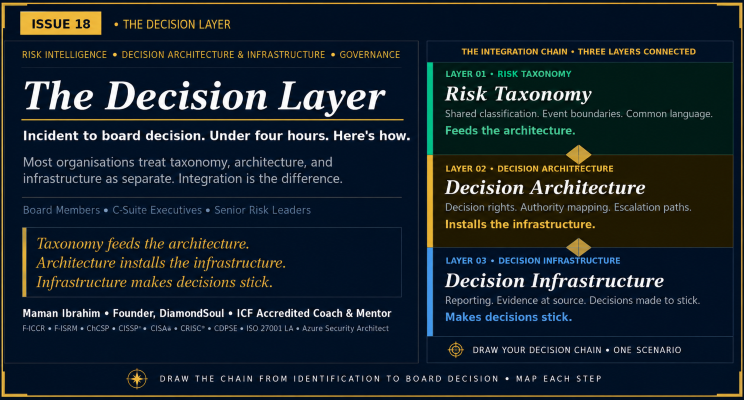
A major disruption moved from incident to board decision in under four hours. Issue 18 shows how taxonomy, decision architecture, and infrastructure work as one connected governance system.
Read intelligenceDecision Infrastructure is the layer that makes consequential decisions authorised, evidenced, bounded, traceable, challengeable and capable of being reopened when the facts change. This Founding Edition introduces its six components.
Read intelligence