
Sharp. Not sentimental.
Same Terms of Reference. One Committee Decides. One Reviews. The Design Is the Difference.
Two financial services firms. Both have board risk committees meeting quarterly. Both have chairs who take governance seriously. Both have well-resourced risk functions preparing thorough papers. The terms of reference are almost identical.
At Firm A, the risk committee makes four to six significant decisions per quarter: specific risk acceptances above management authority, budget approvals for major remediation programmes, adjustments to appetite thresholds, and direction to management on priority risk areas. The decisions are recorded in the minutes by name, with rationale, and followed up at the next meeting.
At Firm B, the risk committee meets for the same duration, reviews the same categories of risk, and produces minutes that record: noted, noted, noted, carried forward, noted.
The chairs of both committees are competent. The papers at both are well-prepared. The membership at both includes experienced non-executives. The difference is not in the people. It is in the design of the agenda, the framing of the papers, and the culture of expectation about what the committee is there to do.
Honest. Not accusatory.
Most Risk Committees Are Designed to Receive Information. Deciding Requires a Different Design.
The default design of a governance committee is oriented toward information flow: management presents, the committee considers, the committee notes. This is appropriate for oversight. It is not governance.
Oversight and governance are different activities. Oversight means watching and monitoring. Governance means deciding and directing. A committee that only oversights is a sophisticated briefing session. A committee that governs makes decisions, gives directions, and ensures both are followed through.
The shift from oversight to governance requires three specific design choices. None of them require changing the terms of reference. All of them require changing how the agenda is structured, how the papers are written, and what the committee chair expects from the secretary before each meeting.
Simple. Not simplistic.
Three Design Choices That Change a Committee From Oversight to Governance.
These three design choices, applied consistently, convert a review-oriented committee into a decision-oriented one. They take effect from the first meeting at which they are implemented.
| DESIGN CHOICE | WHAT IT REQUIRES | WHAT CHANGES |
|---|---|---|
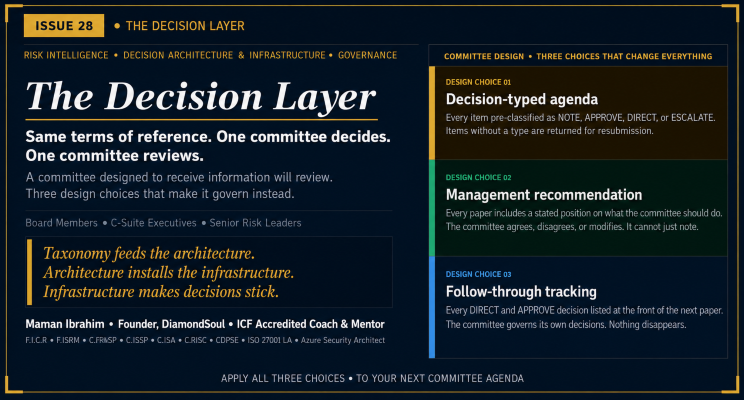
| Decision-typed agenda | Every agenda item is pre-classified as NOTE, APPROVE, DIRECT, or ESCALATE before the meeting. Items without a decision type are returned to the risk function for resubmission. | The committee arrives knowing what it is being asked to do with each item. The secretary can produce draft minutes before the meeting. 'Noted' is replaced by a named action type. |
| Management recommendation | Every paper includes a specific management recommendation — not a description of the risk, but a stated position on what the committee should decide. | The committee can agree, disagree, or modify. It cannot avoid deciding. Silence becomes an explicit decision to agree, which can be recorded. |
| Follow-through tracking | Every DIRECT and APPROVE decision is listed on the following agenda under 'decisions from previous meeting.' Management reports on implementation. | The committee governs its own decisions. Items cannot disappear between meetings. The committee sees whether its directions produced change. |
These three choices work together. A decision-typed agenda without management recommendations produces disagreement about what the committee is deciding. Management recommendations without follow-through tracking produces decisions that don't connect to outcomes. Follow-through tracking without a decision-typed agenda has nothing to track.
Practical. Not obvious.
Apply All Three Choices to Your Next Committee Agenda.
Take the agenda for your next board risk committee meeting.
The reaction to the revised agenda will tell you which of the three choices will face the most resistance. Items that cannot be typed usually lack a clear decision. Papers without recommendations usually haven't been written to support a decision. The standing follow-through item usually reveals that previous decisions were not tracked.
Each of those reactions is useful governance information. The resistance is not the problem. The reasons for the resistance are.
Open. Not pushy.
The Decision Infrastructure Self-Assessment
Committee design is one of the five architecture questions mapped in this assessment. The NOTE/APPROVE/DIRECT/ESCALATE framework from this issue is applied directly in Issue 10 and the architecture arc closer.
Access here →Book a 45-Minute Decision Architecture Conversation
If the agenda redesign exercise surfaces resistance that reveals something structural about how the committee operates, that is the right starting point. Bring the agenda and the reactions to it.
Book a diagnostic session →That's The Decision Layer for this week.
The two committees in this issue have the same terms of reference because terms of reference describe what a committee is for. Design describes what it actually does. The gap between the two is where governance quality is determined.
Forward this to a board committee chair or governance lead who has ever sat in a risk committee meeting and wondered what, specifically, the committee had just decided.